ADHD Assessments
I offer assessments for Attention-Deficit/Hyperactivity Disorder (ADHD) in Hobart at Archer Street Health. Assessments involve the following:
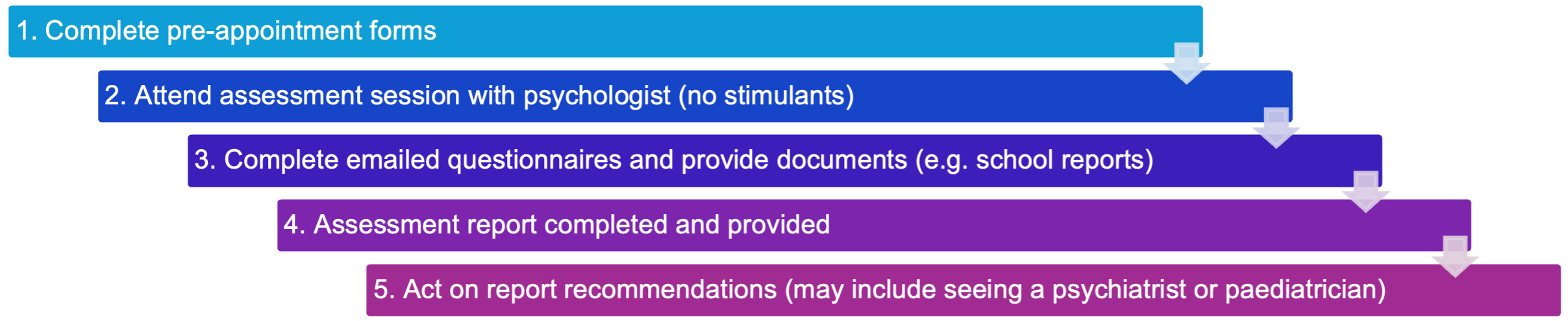
Following the assessment, you may wish to make appointments with a psychiatrist at Archer Street Health. (This depends on the availability of Archer Street Health clinicians, and if you are under 18 you may need to see a paediatrician at another practice.)
Before the Assessment
You will need to complete some questionnaires either before the assessment session or immediately after. The report cannot be finished until these are returned.
Depending on age, forms may need to be filled out by you, your child, teachers, and friends or relatives.
Please provide school reports (even for adults) and any other medical or health reports that relate to attention difficulties.
During the Assessment
The session takes about 50 minutes, in which you will:
Do a computerised test of attention.
Answer questions about symptoms, behaviour, and mental health history.
For best results:
No caffeine or stimulants (coffee, tea, energy drinks) before the test. If you usually have a lot and worry about withdrawal effects, a small amount is okay.
No nicotine for 3–4 hours before.
No creatine, pre-workout, or nootropics before.
Turn phone and smartwatch off or on flight mode during the test.
After the Assessment
Make sure you complete any more questionnaires sent to you.
About two weeks after all information is collected, you will get a report.
The report will:
Explain possible origins of the attention difficulties you are having, including if ADHD is likely or not.
Give recommendations for support.
If medication is wanted as a part of ADHD treatment, a psychiatrist or paediatrician must confirm the diagnosis and discuss treatment. If you don’t have one, ask your GP for a referral.
ADHD Assessment FAQs
Why do I need to do this assessment when I’m pretty sure I have all the symptoms of ADHD?
There are many reasons why someone may have difficulties with attention, impulse control, or executive functioning. ADHD is one diagnosis that has these symptoms, but there are several others. Our assessment process aims to clarify this so you can get the most appropriate treatment.
Why is a psychologist doing this assessment when a psychiatrist/paediatrician is responsible for diagnosis and prescribing?
The assessment process we use at Archer Street Health is multidisciplinary. This means we use more than one clinician with their own unique expertise to achieve a more thorough, well-rounded assessment. Psychologists, psychiatrists, and paediatricians all have their own fields of expertise. By collaborating on assessment and diagnosis of ADHD, we increase the chances of making a correct diagnosis and optimising treatment. Psychologists can diagnose ADHD, but a paediatrician or psychiatrist will be needed if medication is wanted to be a part of treatment.
Why do I have to do a computerised test?
There are many reasons why someone may have difficulties with attention and impulse control. ADHD is one of the diagnoses that has these symptoms. One of the unique ways that ADHD effects attention is at the level of the brain, from moment to moment, on a millisecond basis. The test is designed to measure these fluctuations in attention. It is extremely difficult and unlikely for someone with ADHD to achieve a “normative” result on the test, no matter how much effort they put in, or how much practice they have with video games. The test is also resistant to effects of hyperfocus, as it uses very non-engaging stimuli, specifically designed to assess for ADHD.
What happens if the assessment does not indicate ADHD?
If the assessment does not indicate ADHD, the report will still clarify what is contributing to your experiences. Difficulties with attention, impulse control, or executive functioning can happen for many reasons, and identifying the correct explanation allows us to provide you with evidence-based recommendations for treatment and support. Our goal for the assessment is to give you the best possible chance of creating long-term improvement for the difficulties you’re facing.
Why do you need information from someone who knows me well?
ADHD symptoms are often patterns that occur across different environments. A partner, parent, close friend, or colleague can often give us examples that show these patterns, or show how you function differently in different contexts. Their perspective strengthens the assessment and improves diagnostic accuracy.
Why do you ask for historical information, like school reports?
ADHD is a neurodevelopmental issue, meaning it is present from a young age. A diagnosis requires there to be evidence that you experienced symptoms when you were a child. These can present differently for different people, but usually there is a way of determining what ADHD symptoms were present. Reviewing school reports, the perspective of parents, or other historical information again strengthens the assessment and improves diagnostic accuracy.